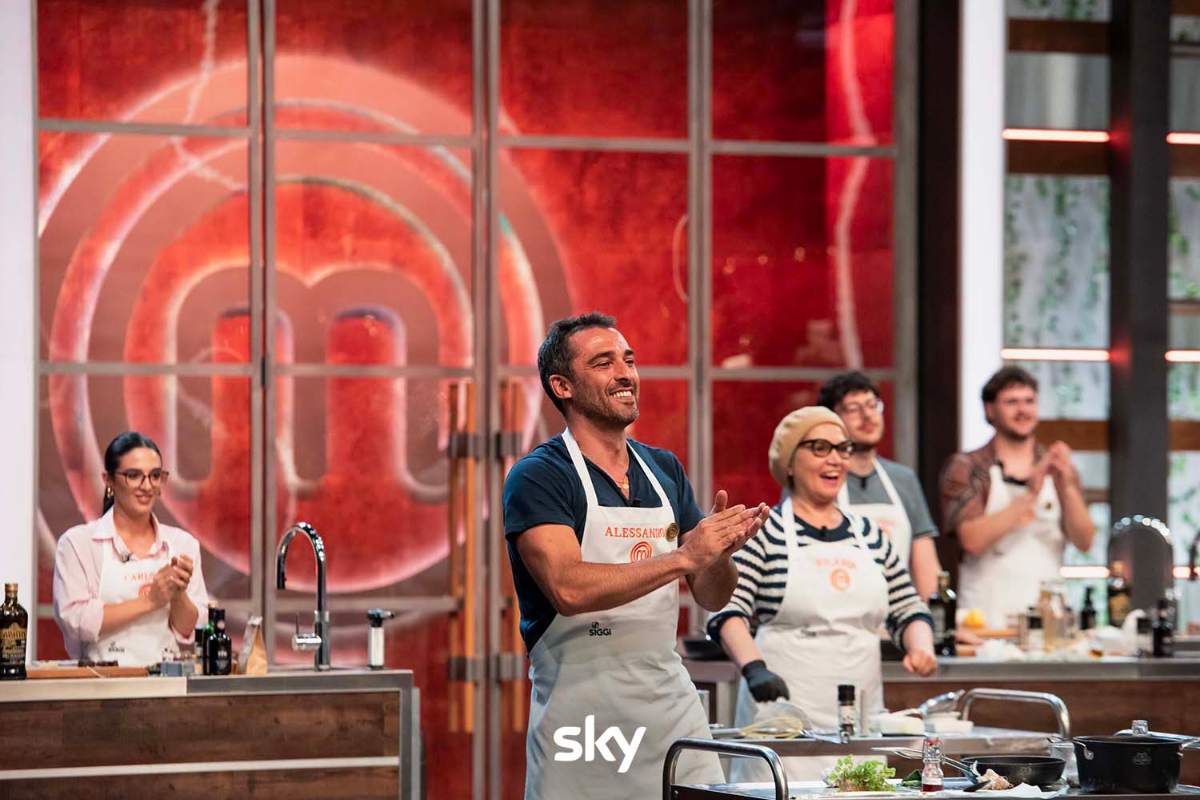
Alessandro Segantini, the Genoese dentist known to the public through MasterChef Italia, reflects on life after the show. Between dentistry and a passion for cooking that refuses to stay private, he shares his vision of wine as a true dialogue partner at the table, and outlines a future where food, people, and connection take centre stage.
There are paths that, after television, return neatly to their former tracks. And then there are experiences that leave an open question. For Alessandro Segantini, a Genoese dentist known to the public through his participation in MasterChef Italia, the point is not to make a clear-cut choice between his profession and cooking, but to understand how to let two important parts of his identity coexist. With one certainty: at the table, wine is not a decorative detail, but an element that can profoundly change the meaning of the experience.
MasterChef Italia, the Sky Original cooking show produced by Endemol Shine Italy, is always available to stream on NOW.
In your daily life you work as a dentist, but the public got to know you in the kitchen: how much do these two identities coexist today?
The MasterChef Italia experience took me away from my professional activity for a significant period and, upon returning, I had to find my rhythm and continuity again. My dental practice in Genoa is something I built over time and that has always grown steadily; the visibility the show brought has, in this sense, contributed to further strengthening that path.
Today, dentistry inevitably occupies the central part of my daily life. Cooking, however, remains an indispensable space — the place where I rediscover a freer, more creative and intimate dimension. I am reflecting on how to give this passion a more shared form as well, taking it beyond the walls of my home. It is not a simple transition, but it is certainly a direction I would like to explore.
What did MasterChef Italia truly leave you with, beyond the visibility?
MasterChef Italia taught me, above all, not to be afraid of chasing a dream. It made me understand that even the most difficult and apparently riskiest choices can bring very great satisfaction. For a long time in my life, reason prevailed over passion; if that had not been the case, I would probably have had an experience like this much sooner.
At a certain point, however, I decided to follow that impulse without giving up awareness. I like to think of that decision as a beautiful kind of madness — but a lucid, considered, and constructed one. What stays with me most of all is a personal transformation. Even in my daily work, in managing the team and in relating to people, I feel I have developed a more open and empathetic outlook. And the reactions I received after the show moved me deeply: knowing that someone found inspiration in my journey is something that goes beyond any expectation.
If you had to describe yourself through a single dish, which would you choose and why?
I would like to describe myself through Capriole, the dish that gave me the greatest satisfaction during MasterChef Italia. It was a moment I still carry with me with great intensity. That dish, in my view, expressed many things: the strength of my passion for cooking, the technical ability to manage the marinade and the cooking of the venison fillet well, the attention to the sauce, and the sense of balance in building a simple but very well-focused side dish of leeks and apples.
Inside that dish there were also opportunism, intuition, aesthetic sensibility in the plating, and a certain determination — because I had to prepare it in a difficult situation, without a fixed station and with constant movement. Ultimately it was a good, technical, beautiful, characterful and overall simple dish. I cannot say whether I truly resemble that dish, but I would certainly like to.
In television storytelling, wine often stays in the background compared to the dishes. In your personal experience, what role does wine play in the overall balance of a table and a gastronomic experience?
I do not consider myself a wine expert, but certainly an enthusiast. For me, wine is a conversation partner for the dish, not a simple accompaniment. When the pairing works, a form of dialogue is created in which food and wine support each other, amplify each other and sometimes contrast in an interesting way. It is a subtle balance that can transform a meal into a much more complete experience.
It is a principle I feel is akin to other dimensions of life as well: when elements are in harmony, the overall result gains depth. Much like what happens in relationships between people, at the table too, food and wine — when well matched — can bring out the best in each other and give rise to truly successful combinations, made of both resonances and pleasant contrasts.
Would you have liked to face a challenge at MasterChef Italia in which wine was the protagonist, perhaps in a pressure test or a food-and-wine pairing challenge? How would you have imagined it?
Yes, I would have liked that very much. I could easily see wine as the protagonist of a Mystery Box, with different wines under the box and contestants asked to choose one to use as the starting point for building their dish. It would be a beautiful and demanding challenge, because it would require not only culinary skills but also sensitivity in pairing.
I think it would be interesting because it would force contestants to think not only about ingredients, but also about cooking techniques and overall balance. Consider meat: a long braise and a quickly cooked piece of meat served rare express completely different characteristics, so the wine to pair with them cannot be the same. It would be a genuine, fascinating challenge, and I would very much like to see a test like that.
When you cook for friends or for special occasions, do you also think about the wine pairing? Do you start from the dish or from the atmosphere you want to create at the table?
The wine pairing is always part of the process. Sometimes it takes shape alongside the dish, other times it comes afterwards, as a natural completion. When I cook for friends, I also like to involve them in the choice, because it becomes a way to make the experience even more participatory.
There are moments when it is the wine that guides everything. A bottle can suggest an idea, evoke a dish, and shape an entire dinner. A nice Piedmontese red, for example, immediately makes me think of braised cheeks; a Ruchè takes me towards spiced dishes. The possibilities are endless, and that is precisely one of the most beautiful aspects: the focus no longer rests on the single preparation, but expands to the experience as a whole.
Is there a territory, a wine style or an idea of conviviality linked to drinking well that you particularly identify with?
What fascinates me most is precisely the fact that there is no single answer. Cibo e vino hanno la capacità di adattarsi ai contesti, di dialogare con l’ambiente e con il momento. Food and wine have the ability to adapt to contexts, to engage with the environment and the moment. A rich dish accompanied by an important red can be perfect on a winter’s day, perhaps in the mountains. Equally, a raw seafood dish with a fresh, mineral white finds its ideal balance on a summer evening by the sea.
For me it is not just a question of technical pairings, but above all of atmospheres. That, in my view, is where the most interesting part of the gastronomic experience is played out.
I know you are a Genoa FC fan: supporting a team, like cooking, has a lot to do with identity, belonging and sharing. Do you see a connection between these passions and the way you experience the table?
For me, cooking is first and foremost about sharing, and in this sense the parallel with being a football fan is immediate. A football match often becomes a pretext for being together, for gathering around a table, for building a shared moment. It happens with Genoa, it happens with the national team: the emotions change, but the value of sharing does not.
There is also an almost narrative dimension in the choice of food, because the menu adapts to the context, the guests and the occasion. I remember, for example, watching the 2006 final with friends while making pizzas for everyone: it was the most fitting thing to do at that moment, certainly more so than a meal constructed in an artificial way. These are simple situations, but they show well how powerfully food and wine can be instruments of connection. And then, of course, one thing always remains constant: forza Genoa.
After MasterChef Italia, do you also picture yourself in live settings such as events, showcooking and gastronomic experiences where cooking, territory and dialogue with the public can meet?
Yes, it is a prospect that interests me greatly. Events, showcooking and gastronomic experiences are settings in which cooking steps out of the private dimension and becomes an occasion for encounter. It is a different form of sharing — more open and more dynamic.
The idea of a restaurant still holds its appeal, but today I feel closer to experiences that allow direct contact with people and that maintain a more fluid and less structured dimension.
Looking ahead, how do you picture your path in the food and wine world? Are there projects, formats or areas in which you would like to test yourself?
Looking ahead, I would like to find a synthesis between the skills I have built in my work and my passion for cooking. In my dental practice in Genoa I have built a team over time, and this has taught me how central the dynamics between people are: communication, trust, the ability to collaborate.
Cooking, from this point of view, is a very interesting terrain, because it is a place where these dynamics emerge naturally. I would like to explore settings in which these two worlds can engage in dialogue, building experiences that are not tied solely to food, but that also have a relational and, in some way, formative dimension.
Key points
- After MasterChef Italia, Segantini returned to his dental practice while continuing to pursue cooking as a creative outlet.
- The show sparked a personal transformation, making him more empathetic in both his professional and daily life.
- For Segantini, wine is a conversation partner for food — not a decoration, but a core part of the dining experience.
- Sharing is the common thread connecting cooking, football fandom, and his vision of conviviality at the table.
- He is open to showcooking events and experiences that blend culinary passion with human connection and a formative dimension.