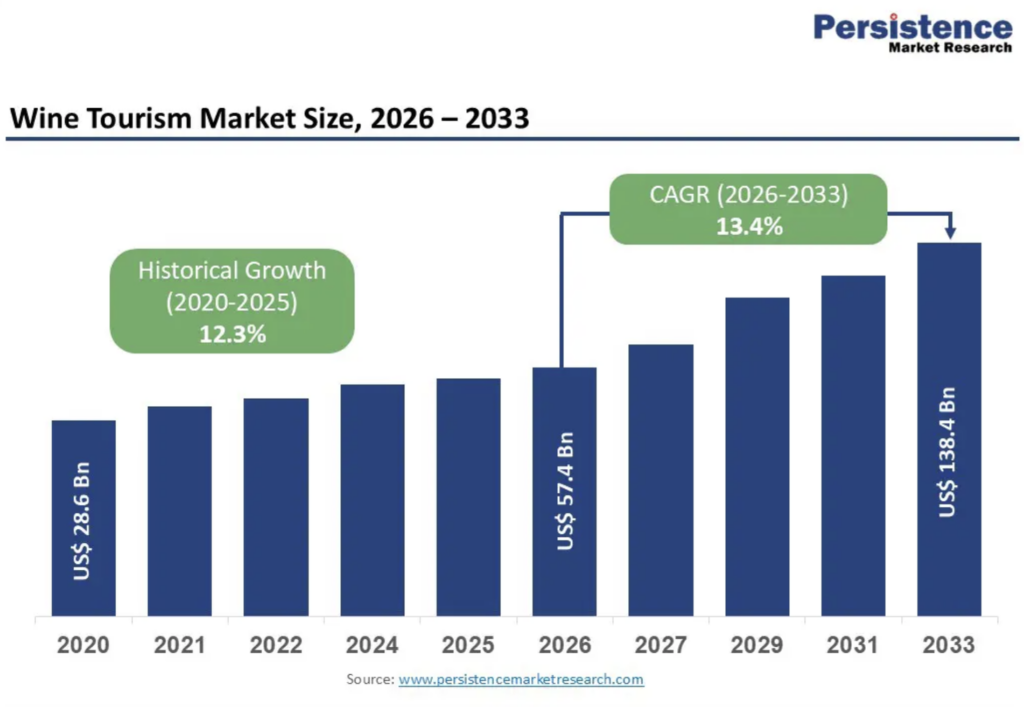
Wine tourism is set to become a global economic pillar, with the market projected to reach $138.4 billion by 2033 at a 13.4% CAGR. Europe still leads, but Asia Pacific is growing fastest. Bureaucracy, climate change and geopolitical instability remain key challenges, while sustainability emerges as the strategy to secure long term revenue.
Contemporary travel is rapidly moving away from the traditional concept of the quick hit and run vacation. Today’s travelers demand stories, connections and, above all, authentic experiences. This paradigm shift explains the extraordinary evolution of wine tourism, a segment that is shedding its image as a hobby for enthusiasts and establishing itself as a fundamental pillar of the global tourism economy.
A recent study by Persistent Market Research traces a very clear path: the global wine tourism market is set to reach $138.4 billion by 2033 (around 119.7 billion euros). This momentum, fueled by rising disposable income and a clear preference for experiential wine tourism, will translate into a compound annual growth rate (CAGR) estimated between 13% and 13.4% starting in 2026. This represents a notable acceleration, considering that in the previous five year period (2020 to 2025) the sector still grew at a solid +12.3%.
Experience at the center and the digital revolution
What are tourists actually looking for when they enter a winery? Data shows that tastings and guided tours remain the leading category, representing 52% of the market in 2025. However, the offering is becoming more specialized: visitors now look for interactive harvests, bike routes through the vineyards and food and wine pairing workshops, going well beyond a simple glass of wine.
This structural evolution goes hand in hand with digitalization. Consumer habits have changed even before travelers set off: online marketplaces captured 45% of bookings in 2025 and remain the fastest growing channel. Wine companies are investing heavily in personalized booking apps, interactive maps and even augmented reality previews, tools capable of creating secondary revenue streams and building loyalty among international audiences well before their physical arrival at the winery.
Europe’s leadership and the Italian model
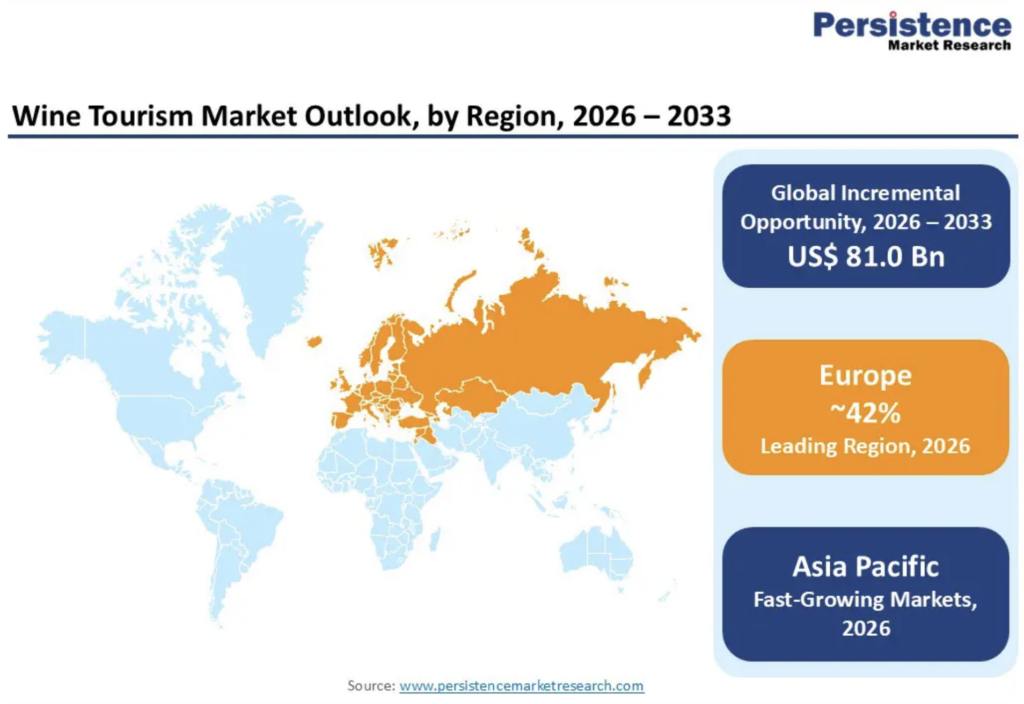
Geographically, old Europe continues to hold its ground. In 2025 the continent defended a 42% market share, accounting for nearly two out of every five global transactions. Iconic regions such as Bordeaux, La Rioja and Tuscany retain their full appeal, supported by centuries old tradition, brand protection systems (such as protected designations of origin) that guarantee consumer trust, and significant structural investments. The upgrading of railway networks, the creation of cycling routes and the development of accommodation facilities within estates have allowed the average length of visitor stays to be extended.
In this scenario, Italy stands out as a case study for its ability to generate value. According to Nomisma data, produced in collaboration with UniCredit and Vinitaly, in 2025 the country welcomed over 138 million tourists linked to this sector, generating 3.1 billion euros in direct revenue for wineries across the peninsula. For Italian companies, wine tourism has become a central item in their balance sheets, accounting on average for 21% of total company revenue.
Asia Pacific races ahead, North America goes digital
While Europe consolidates its position, the Asia Pacific region is the true engine of global growth. Already holding a 32% share in 2025, the region is credited with a record growth rate of 15.2% per year through 2033. This momentum is driven by the expansion of the middle class and government strategies in countries such as China, where the Ningxia region is rapidly transforming into a world class wine tourism hub to meet strong domestic demand.
Similar dynamics can be seen in India, where wineries such as Sula Vineyards in Nashik and Grover Zampa in Karnataka combine wine culture with music festivals (such as SulaFest) and wellness experiences. On the other side of the ocean, North America is responding with projected growth of 12.8% per year between 2026 and 2033.Here, the key to success lies in technological integration and the creation of premium packages that combine the winery experience with outdoor activities and fine dining, maximizing average spending per visitor.
Shadows: bureaucracy, climate and winds of war
The macroeconomic picture outlined by analysts is undoubtedly encouraging, though producers must navigate genuinely challenging waters. Strict alcohol regulations represent the first bureaucratic obstacle: in many countries, limits imposed on the volumes served during tastings, on direct on site sales and on opening hours reduce producers’ flexibility in designing experiences.
A further critical issue concerns the seasonality of visitor flows, which tend to concentrate almost exclusively during the harvest months or alongside local festivals. This strong seasonal dependence exposes smaller wineries in particular to significant financial uncertainty for the rest of the year.
Climate change further complicates these plans, with prolonged droughts and extreme weather events destabilizing harvests in historic areas such as Bordeaux and Rioja, alongside deep geopolitical instability. The impact of conflicts is devastating in direct crisis areas: in Lebanon, for example, war tensions and bombings have effectively wiped out the local wine tourism market, a dramatic reality confirmed by historic producers such as Chateau Musar.However, the shockwaves of geopolitics are also felt in seemingly safe destinations, such as Champagne or Tuscany itself, where international instability ends up altering and reducing the flow of wealthier cross border travelers.
Sustainability to stabilize revenue
The recipe for overcoming these vulnerabilities and stabilizing revenue in the long term appears to converge on a single factor: environmental sustainability. Travelers are showing an increasingly strong sensitivity toward protecting the land and reward companies that demonstrate responsible management of natural resources.
Low environmental impact experiences and organic or climate efficiency certifications are becoming powerful tools for attraction and positioning. Historic regions such as the Douro Valley in Portugal and the Barossa Valley in Australia are fully integrating sustainability into their wine tourism development guidelines.
The goal, now shared globally, is clear: to transform the vineyard from a mere site of agricultural production into a space for landscape and cultural preservation, giving companies a solid, ethical and diversified business model capable of withstanding the challenges of tomorrow.
Key points
- Global wine tourism market will reach $138.4 billion by 2033, growing at a 13.4% CAGR.
- Europe holds 42% market share, while Asia Pacific grows fastest at 15.2% annually through 2033.
- Italy generated 3.1 billion euros in direct wine tourism revenue in 2025, per Nomisma data.
- Bureaucracy, climate change and geopolitical instability threaten growth, especially in crisis affected regions like Lebanon.
- Sustainability is becoming essential for attracting travelers and stabilizing long term winery revenue streams.