In the 1950s, Patriarche became the first Burgundy house to open its cellars to tourists, when other producers kept their doors firmly shut. Today its five kilometers of galleries beneath Beaune welcome forty five thousand visitors a year through a pioneering self-guided model, alongside contemporary art and a legendary sealed treasure room.
In Beaune, in the heart of the historic center, two dark wooden doors at number 7 Rue du Collège don’t seem to say much. Those two wooden doors, however, hide five kilometers of galleries beneath a former convent from 1632, two million bottles, a self-guided system that has been running for seventy years and today experiments with apps, contemporary art and souvenir glasses.
Patriarche Père et Fils, founded a few years before the French Revolution, is one of the Burgundy houses that came through the twentieth century least unscathed: six generations of the Patriarche family until the early twentieth century, then a friendly handover to the Boisseaux family, and finally, in the late 1990s, acquisition by the Castel group, among the largest wine estate owners in France.
But this is not the story told by Pierre Borsato, Hospitality Manager and our guide through the maison, as he accompanies us into the cellars. The story he tells is another one. It is the story of how André Boisseaux, who led Patriarche between the 1950s and the 1990s, essentially invented the Burgundian wine visitor center.
The pioneer
“When we talk about wine tourism, we must remember that in the 1950s no Burgundian producer wanted visitors in their own cellars,” explains Pierre. “It was considered unusual, annoying, even suspicious. Boisseaux was the first to say: why not open the doors to customers, to tourists? Why not show what we do?”
The question, today, sounds rhetorical. Seventy years ago it was heretical. The great houses of Beaune, Bouchard, Drouhin, Latour, Jadot, were cathedrals locked tight, jealous keepers of a family knowledge. Wine was sold to merchants, exported through established networks of importers, but the end consumer did not come in.
Boisseaux understood before anyone else that the tourist, what today we call, still a somewhat new term at the time, the “wine tourist,” was a better customer than he seemed. He bought directly at the cellar, paid full price, and went home carrying a story with him, and that story was worth more than any advertisement.
To welcome those visitors, Boisseaux transformed the old galleries of the convent, already used for winemaking since the seventeenth century, into a route open to the public. When the space began to no longer be enough, he did something still told today in Beaune as a legend: he went and knocked on the neighbors’ doors, asking to buy their private cellars, one after another.
He connected them with underground corridors dug into Burgundian limestone. From this came a network of galleries on multiple levels, from the seventeenth, eighteenth and nineteenth centuries, which today wind for five kilometers beneath the historic center of Beaune, holding two million bottles and wines dating back to 1904.
The self-guided model: anomaly or the future?
In Burgundy, the dominant model for cellar visits is guided. A sommelier, a small group, a scant hour and a half, a final tasting of four or five references. Patriarche does the opposite: the visitor enters, receives a map, goes down alone, decides how much time to spend in each room, going up and down the different levels at their own pace.
Only at the end, once back on the surface, does the visitor meet a sommelier for the tasting. The numbers tell of a model that works. Forty five thousand visitors a year, of which more than eighty percent unguided. Seven to eight thousand guided tours with a sommelier. In high season Patriarche is forced to close its doors and limit entries so as not to overwhelm the tasting spaces.
“We want visitors to have time to talk with the sommeliers, to taste calmly,” explains Pierre. “If too many people come in, the experience becomes trivial.” The editorially relevant point is not that Patriarche does self-guided visits, but that it does so in Burgundy, the wine region in the world most obsessed with producer mediation, first person storytelling, and the direct relationship between sommelier and visitor.
Patriarche shows that one can also choose the opposite: giving the visitor room to discover things alone. And that, done well, it works. Patriarche remains one of the few places in the world where a visitor can, literally, get lost inside the company for an hour and a half.
And “getting lost” is not an exaggeration: five kilometers of galleries with discreet lighting, continuous forks, rooms opening into rooms, are effectively a small labyrinth. Pierre admits with a laugh: “Let’s say we don’t want visitors to get too tired. We try to take them along a route of a kilometer, a kilometer and a half. But if someone wants to do the full five kilometers, we don’t stop them.”
The chapel, the treasure, contemporary art
The route is not only about the history of wine. The first stop is the convent’s chapel from 1632, today transformed into a museum of winemaking art: historic vats displayed as museum pieces, ancient winemaking tools, a small permanent exhibition. “We have just signed a contract for the complete restoration of the chapel,” says Pierre with clear pride, “we are redoing the roof and restoring the walls, and this is because we want to protect it for future generations.”
For five years, Patriarche has also hosted a contemporary art program. International artists exhibit installations directly in the underground galleries, several different ones each year. “We like this because when visitors come back the following year, they find everything different,” explains Pierre. “And we too, frankly, discover our own cellars with new eyes each time.”
And then there is the Treasure. A room closed by an iron gate, behind which Boisseaux had five hundred and four bottles walled up in 1959, a vintage still recognized today as one of the greatest ever produced in Burgundy. He locked them with a generational promise: they would only be opened after fifty years.
In 2009, James and Monique Boisseaux kept the promise: they opened the gate with three symbolic keys, one to the maison, one to the Hospices de Beaune, one to the mayor of Beaune, sommeliers from the Ardennes tasted every bottle, and French television broadcast the event. The public called it “la dégustation du siècle,” the tasting of the century.
Today in the room only a few original bottles remain, from 1934, from 1959, some Romanée Conti, Chambertin, Bâtard Montrachet, Clos de Vougeot, Hospices de Beaune, protected like relics. “They are not for sale,” explains Pierre, “they are the treasure of the maison.”
One of the 1959 bottles will soon leave the cellar, however. Patriarche will donate it to the charity auction on September 19 at Clos de Vougeot, in collaboration with other domaines and houses of Burgundy, to fund the restoration of the Abbey of Cîteaux, the place where, in the twelfth century, Cistercian monks essentially founded modern Burgundian viticulture by inventing the concept of climat. A narrative circle that closes well: a bottle donated by those who pioneered opening up to visitors, in favor of the place that pioneered the very concept of terroir.
App, profile, souvenir glass: the next frontier
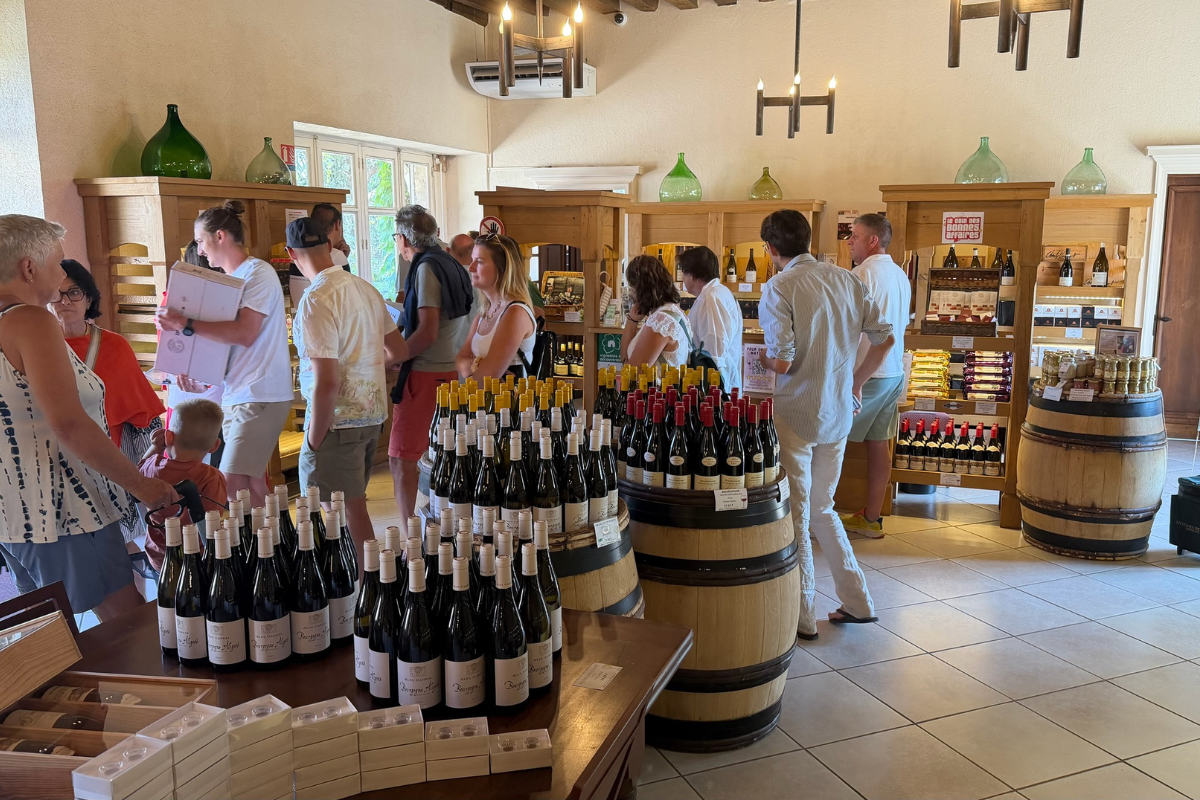
At the end of the route, in the convent’s former kitchen, comes the commercial moment. Six wines for tasting, from the regional Bourgogne to the Premier Crus of the Côte de Beaune, up to a hint of Grand Cru. Every visitor receives a personal souvenir glass to take home.
A small detail, but of great symbolic effectiveness: the visitor leaves with a physical object that connects them back to the maison every time they use it at home. As we climb back up toward the light, Pierre says that most of the international visitors who come here are interested in wine, yes, but above all in the history, the culture, the architecture.
“They come for the wine and discover the convent,” he sums up. “Or, perhaps, they come for the convent and discover the wine. For us, in the end, it is the same thing.” This is probably the best summary of what wine tourism means in 2026: wine is no longer the starting point, it is the destination of a journey that crosses history, architecture, gastronomy, art and, eventually, technology as well.
The cellars that understand this, and that build routes able to welcome visitors who come in for different, and all legitimate, reasons, will win the next phase of world wine tourism. Those that keep thinking they are selling “only” wine will lose it.
Key points
- Patriarche pioneered wine tourism in the 1950s when Burgundian producers kept cellars closed to visitors.
- Boisseaux expanded the cellars by buying neighboring properties, creating five kilometers of underground galleries.
- The self-guided model lets most visitors explore alone, with a guided tasting only at the end.
- A hidden treasure room holds bottles sealed in 1959 and opened only fifty years later.
- Contemporary art and restoration projects keep the historic convent chapel and cellars evolving each year.