Generative AI is changing how tourists search for wineries, yet human advice still carries more weight when the final choice is made. Surveys show consumers use AI for inspiration and verify it with friends, locals, and sommeliers. Wineries missing from AI answers risk staying invisible at the start of the decision journey, in a market where visits are falling.
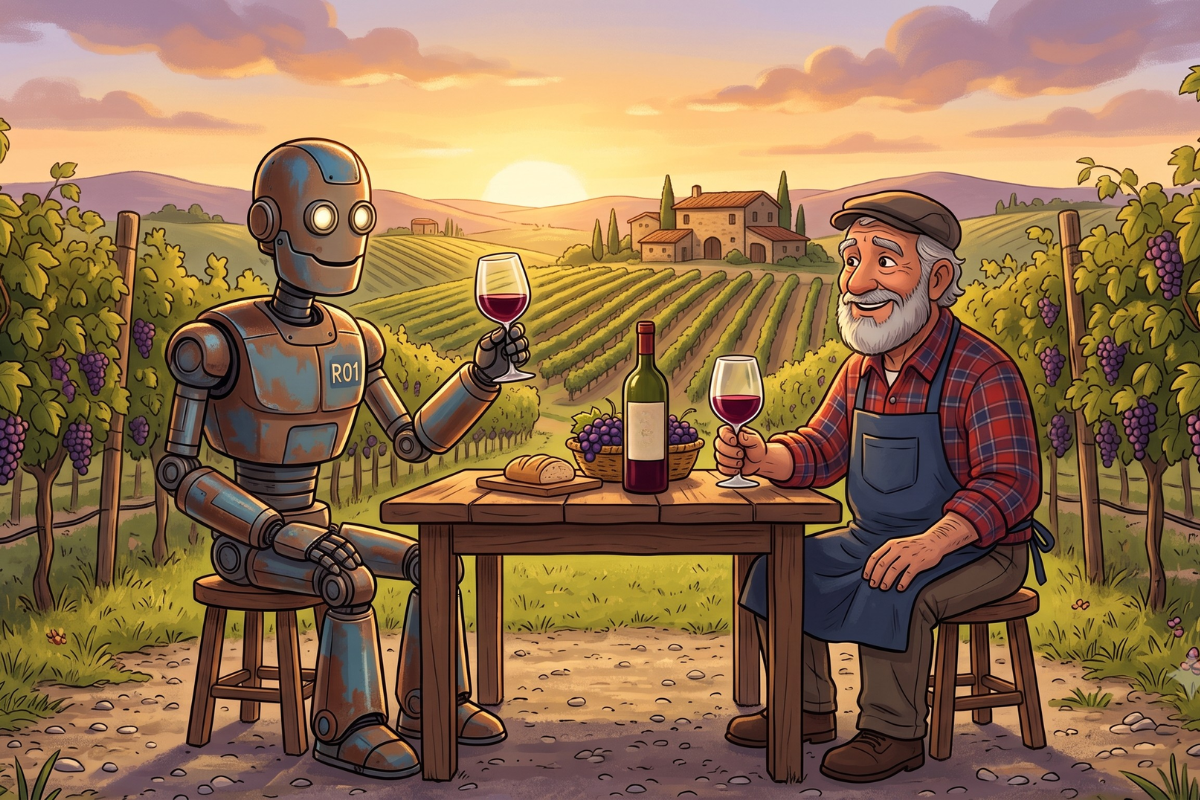
Let’s imagine two tourists having dinner in the Loire Valley. The restaurant owner, who knows the area like the back of his hand, recommends a small winery a few kilometers away: he explains why, tells the winemaker’s story, and describes what the place is like. Back at the Airbnb, one of the two tourists, out of curiosity or habit, picks up the phone and asks ChatGPT which wineries to visit in the area. The winery recommended by the owner does not appear in the results.
What do the tourists do at that point? In reality, this scenario is already everyday life for many people, rather than an experiment, and it poses a question to the wine sector: now that generative artificial intelligence has become a direct interlocutor for consumers, how much does human advice still weigh?
Until a few years ago, search worked differently: users searched on Google, analyzed the links, compared sources, and made a decision. Today that process has changed: you ask AI a question and get a direct answer, already synthesized, ready, clean, and direct. There is no longer a list of results to explore, there is a single answer. And the winery that does not appear in that answer, for the consumer, might simply not exist.
We have already talked about this: appearing in the answers of language models has become, in effect, the new SEO. The parameter has shifted from “how high you rank on Google” to “whether you are cited when someone asks AI what to visit this weekend in area X.” And it is a far more opaque parameter, far less controllable, and for many small producers still completely unknown.
Do consumers really trust AI?
According to research commissioned by Chelsea Co. and conducted by Leadership Factor on over 1,000 regular alcoholic beverage consumers in the United Kingdom (as reported in The Drink Business article, Digital influence is growing but consumers still trust people over AI for drinks recommendations), 43% of consumers still discover wine brands directly in stores and 42% through friends and family. The digital channel, broadly understood, comes after.
And when these same consumers are asked which sources they trust, the answer is even clearer: 60% of 18 to 34 year olds say they instinctively prefer brands they perceive as having a “human touch.” Among those over 55 this percentage rises to 75%, but the figure among young people is the one that should make us think the most: even the generation that grew up with digital, when it comes to trust, still prefers the voice of a person.
And it is precisely here that consumer behavior reveals its real complexity. The most recent data show that the relationship between AI and purchase decisions differs from what we imagine: linear, automatic, substitutive. It is much more nuanced. According to the Italian Food and Wine Tourism Report 2025 by Roberta Garibaldi, president of AITE, Associazione Italiana Turismo Enogastronomico, reported by WineNews (75% of young wine tourists ask AI ideas and inspiration for food and wine tourism), in all the markets analyzed the use of AI as a source of inspiration exceeds the perception of its reliability.
In other words: tourists use AI to form an idea, rather than to make a decision. And that first idea is systematically compared with more traditional sources, first and foremost the advice of friends, family, or those who know the area. The tourists in our Loire example, in all likelihood, do not ignore the advice of the restaurant owner. They verify it on AI. And if AI does not confirm it, it is AI that loses credibility, rather than the owner’s advice.
This is the point the sector needs to understand. According to the research published in the Journal of Marketing Research by Longoni and Cian (Darden School of Business, University of Virginia, Nearly 60% Use AI to Shop, Here’s What That Means for Brands and Buyers), consumers tend to trust AI for practical and functional decisions, but continue to prefer human judgment when it comes to emotional or hedonic products. Wine, and even more so the winery visit, the experience of a territory, undoubtedly belongs to the second category.
But if consumers use AI as a starting point and then cross-check the results with human sources, should the winery that does not appear in AI not even enter the verification process? It is not searched for, not compared, not discussed. It remains invisible in the initial phase of the tourist’s decision journey and this, in a market where the number of visits per winery per trip is declining, is a concrete problem.
Data on Italian wine tourism confirm this pressure: according to the most recent surveys reported by Vinetur (Italian Wine Tourism Set to Attract 18 Million Visitors in 2026 as Demand for Authentic Experiences Surges), tourists now visit fewer wineries per trip than two years ago; three or more stops in 2026, a 12% decline compared to 2024. Every winery must earn a place in an increasingly selective itinerary. And if it does not exist in the digital inspiration phase, it will hardly exist in the choosing one.
Unless it is recommended by a flesh and blood person… In this regard, what does the winery recommended by the restaurant owner do, then, if it does not appear in AI results? It counts on the fact that human advice is worth more than an algorithm, and for now, the data confirm it.
Trust in human advice will not disappear. The restaurant owner, the sommelier, the friend who knows that area: these figures will remain decisive in the final choice phase. But the inspiration phase, the one in which people decide even just to start searching, is increasingly becoming AI territory, and those who do not cover that phase leave the door open to others.
Key points:
- Human advice still decides the final choice of a winery, according to consumer research.
- AI drives inspiration, while tourists verify its suggestions with trusted people.
- Wineries absent from AI answers risk invisibility at the start of the decision journey.
- Visits per trip are declining, so each winery must earn its place in the itinerary.