There is a lot of talk today about wines that are fresher, lighter, and lower in alcohol. But how much does this trend really represent the average consumer? And how much does it mainly reflect the taste of a more involved niche made of professionals, enthusiasts, and wine lovers willing to spend more?
This is not a secondary question. In Italy, as in many other markets, part of the industry seems to be moving quickly towards paler, more vertical, and more immediately drinkable wines. This direction is often presented as inevitable, almost as if the market had already fully accepted it. But is the real consumer, the one who buys wine in supermarkets, discount stores, and general retail channels, really moving in the same direction?
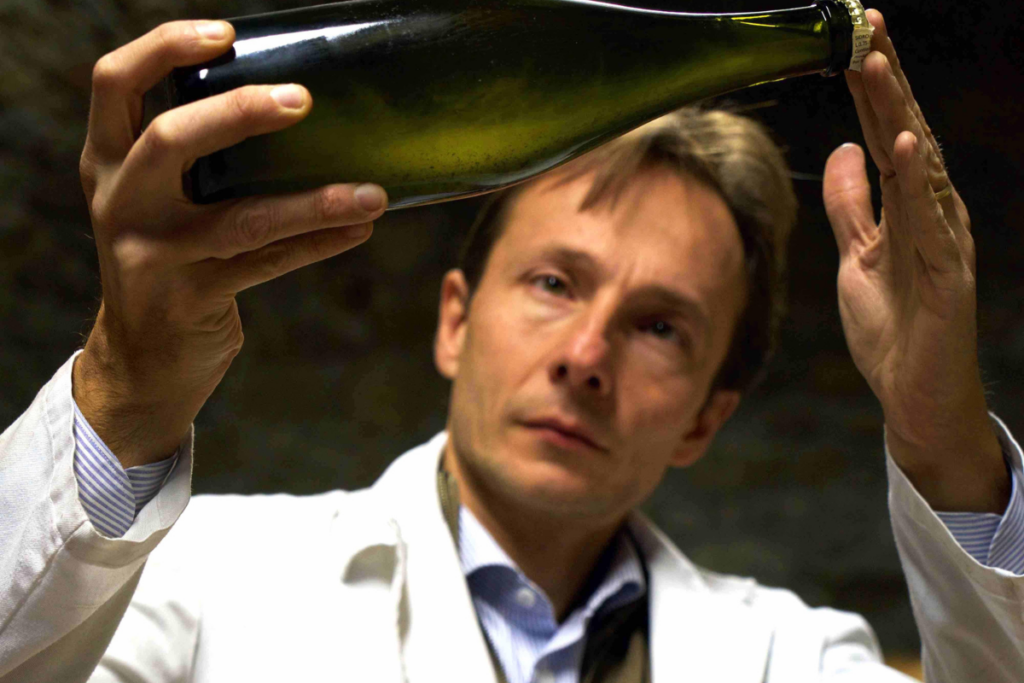
We discussed this with Konstantin Baum MW, German Master of Wine, entrepreneur, educator, and one of the most followed wine voices on YouTube. The starting point was one of his videos dedicated to the most controversial wines, often criticised by experts but still able to achieve strong commercial results. It is only an apparent paradox: what the wine world looks at with suspicion, consumers may continue to choose without many doubts.
According to Baum, the main point is that there is not just one wine market. And perhaps part of the industry tends to forget this exactly when it talks about trends.
Today there is a lot of talk about lighter, fresher, easy-drinking wines. But is the whole market really moving in that direction?
I don’t think it is correct to talk about the wine market as if it were one single big block. This is one of the most common mistakes. Wine, in the end, is always fermented grape juice, but it is sold in very different ways, at very different prices, and it answers very different needs.
For this reason, I think we need to think in terms of segments. There are consumers, channels, and price ranges that have very little in common with each other. For example, I am obviously very deep into the wine world, but for my personal consumption I am not really interested in wines sold in German supermarkets or discount stores under 10 euros. And yet, those wines probably represent 90 or 95% of all the wine sold in Germany.
So, if we want to talk about the real market, we need to start from there. Not from the segment that interests us as professionals or enthusiasts. My personal consumption belongs to a completely different segment, maybe between 15 and 50 euros. For many consumers, this is already almost a luxury price range, while for me it can still be relatively affordable. In that range, I look for wines that are expressive and interesting, maybe fresher and lower in alcohol, because I also like to drink more than one glass. I don’t drink wine to get drunk, but to enjoy it.
But this is a niche. In Germany, it may represent perhaps 2%, perhaps 4% of the market. That is where we find people who talk about lighter, more lively, lower-alcohol wines. It is us “wine nerds” who talk like that. The largest part of the market is not necessarily looking for this.
So the narrative around lighter wines risks being more of a conversation among insiders than a real picture of actual consumption?
Exactly, at least if we look at the market as a whole. A small part of the market may be increasingly interested in lighter, fresher, lower-alcohol wines, but most consumers have different priorities.
The largest part of the market is looking for affordable wines, or in any case wines that are not expensive, with a pleasant taste and that help people relax at the end of the day. In that segment, more alcoholic, softer wines, maybe with a bit of oak, continue to work well. It is no coincidence that in Germany we drink a lot of Primitivo from Puglia, which is certainly not a light wine, but it is a very successful category.
This does not mean that the trend towards fresher wines does not exist. It does exist, but we need to understand where it exists. If it concerns a minority of more involved, more informed consumers who are willing to spend more, we cannot automatically turn it into the new direction of the whole market.
What really matters in the purchase decision of the average consumer?
Price remains central. If we look at the market in general, it is probably the main factor in the purchase decision. Then other elements come into play: colour, because many consumers drink only white, only red, or only rosé; origin; grape variety; region; or very visible elements on the bottle, such as medals, stickers, and scores.
A consumer can be influenced by a gold medal, by an award, or by a very high score, even when this kind of language may make insiders smile. But for many buyers, all these elements are part of the package that makes a bottle easier to understand or more reassuring.
That said, in most purchasing decisions, price remains the decisive variable. There are many people who have never bought a bottle above 5 euros. For them, it is not always so important whether it is Sauvignon Blanc, Chardonnay, red, or white. They simply would not spend 30 euros on a bottle of wine.
From the point of view of Italian wines, which styles still have space in the German market?
Primitivo from Puglia is certainly a very strong category in Germany. I would not necessarily talk about single best sellers, but that style has found an important audience. It is immediate, recognisable, often soft and rich, so it is very far from the idea of light wine that is often discussed among professionals.
Ripasso and Amarone, even if they usually belong to higher price ranges, can also reach a similar taste profile: fuller, more intense, more generous red wines. Of course, Amarone and Ripasso are different products with different positioning compared to many commercially successful Primitivo wines from Puglia, but they show that there is still space for important red wines.
And this does not concern only the basic consumer. Even among people who are more involved in the wine world, there is a segment that still appreciates big, rich, structured red wines. The idea that this taste has simply disappeared is too simplistic.
And what about white wines? Are there any particularly strong varieties or styles?
It is difficult to have a precise picture, because in Germany sales data is not always transparent. Some of the main wine distribution channels do not publish their data in detail. This makes it difficult to know exactly what really sells the most.
That said, Sauvignon Blanc is certainly a very popular variety at the moment. At the same time, in the entry-level segment, there are also many wines made from Mädchentraube, a grape variety mainly found in Eastern Europe and able to produce fruity wines. It is an interesting example because it reminds us how distant the mass market can be from the more technical or quality-focused conversations of the industry.
Looking at out-of-home consumption, how important is the wine-by-the-glass offer today? Can it help restaurants and wine bars bring consumers closer to wine?
It depends a lot on the type of place. In the average German restaurant, the wine-by-the-glass selection can still be quite limited and not always very interesting. But there are also wine bars and higher-level restaurants that work very well on this side.
In Munich, for example, there is Sticks & Stones, which is more a wine bar than a restaurant. It has a very large wine list and offers practically all the wines by the glass. It is an extreme example, but it shows that this direction is possible.
In general, I think there is a trend towards a wider and more curated wine-by-the-glass offer, and I see it in a positive way. But you do not necessarily need huge numbers. Sometimes even six wines by the glass can be enough, if they are well chosen, if they make sense, and if they change regularly. The point is not to multiply the number of references, but to make the offer interesting.
This is also a question of accessibility. Wine by the glass can be a way to let consumers discover different wines without forcing them to buy a whole bottle. But there must be a real selection, not just a list put there to cover white, red, and sparkling wine.
The message that emerges from Baum’s view is clear: wine is changing, but not the whole market is changing at the same speed. The push towards freshness, lightness, and lower alcohol exists, but it mainly concerns a smaller and more involved part of consumption. The broader market still follows simpler logics: price, recognisability, colour, grape variety, and immediate taste.
For wineries, the real question is understanding which market segment they are addressing.
Punti chiave
- Wine market: it is not one single block, but a set of different segments.
- Lighter wines: they mainly interest a niche audience, not the broader market.
- Price: it remains the key factor in most purchasing decisions.
- Italian wines: Primitivo, Ripasso and Amarone still have strong market potential.
- By-the-glass offer: quality matters more than the number of references.