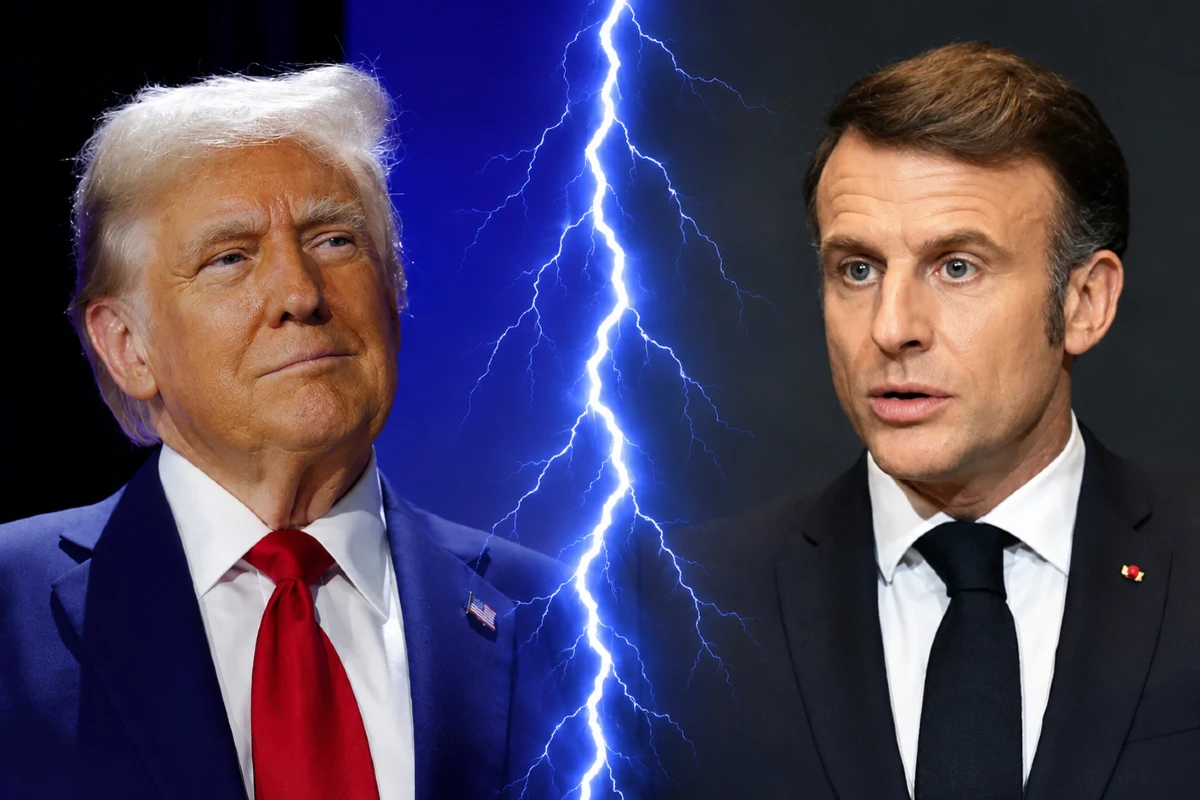
Donald Trump has threatened 100% tariffs on French wine and Champagne if France maintains its digital services tax targeting American tech giants. While this geopolitical clash severely threatens French exports to the US, it presents both an immediate market opportunity and a systemic long-term risk for competing Italian wine producers.
As international diplomacy gathers around the tables of the G7 summit, the transatlantic air becomes heavy again. The climate was ignited by an exclusive interview given in mid-June by Donald Trump to the New York Post, in which the American president issued a peremptory ultimatum to the Elysée. He demanded they eliminate the digital services tax imposed on Silicon Valley giants or prepare to face 100% tariffs on all wines and champagnes arriving in the United States.
“I have no choice,” Trump declared, calling the French tax levy that targets giants like Google, Apple, Meta, and Amazon unacceptable. This move risks plunging the trade relations between Washington and Paris into a new, exhausting tariff war.
The numbers of an announced crisis
The dispute is not new, but the current escalation promises unprecedented structural damage. The French legislation, approved in 2019, provides for a 3% rate on the digital revenues of large multinational technology companies.According to data from the Ministry of Finance in Paris, this measure alone generated approximately 700 million dollars last year. This is a significant figure for the French coffers, but for the White House, it represents an unacceptable discrimination against American businesses.
The French wine sector thus finds itself, once again, acting as a geopolitical hostage in a dispute that does not belong to it. Currently, French bottles destined for the United States already face a 15% tariff, a result of fluctuating tariff events, after the specter of a surtax had even reached 200% at the beginning of the year. This restrictive regime has already taken its toll, as in 2025 the exports of French wine and spirits to the American market collapsed by 21%, stopping at about 3 billion euros.
French Minister for the Economy and Digital Affairs, Roland Lescure, expressed strong concern, recalling how “disproportionate” measures inevitably correspond to equally harsh retaliations. The associations of French producers are on a war footing, forced to suffer the effects of a perfect storm between unfavorable exchange rates and insurmountable customs barriers.
The Italian side: between commercial cynicism and fear of contagion
While in Paris the potential damages are counted, in Rome and among the rows of the main Italian denominations, the analysis of the situation is complex, profound, and devoid of easy triumphalism. From the point of view of Italian wine producers, the scenario clearly bifurcates between an immediate market opportunity and a serious systemic warning.
On one hand, the existence of a potential substitution effect is undeniable, as the United States remains the world’s leading consumer market for wine. If the prices of Bordeaux, Burgundy, or French Champagne were to double overnight due to the 100% tariffs, a substantial slice of American consumers, restaurants, and large-scale retail will seek alternatives of an equal level.
Great Italian sparkling wines, from Franciacorta and Trentodoc to the commercial driving force of Prosecco, would find themselves in a position of clear competitive advantage. Similarly, great aging reds like Barolo, Brunello di Montalcino, and Chianti Classico would be able to fill the void left by historical competitors.
On the other hand, the most far-sighted Italian winemakers look at the situation with extreme caution. The protectionist policy of the White House does not stop at the French borders. Trump has repeatedly reiterated his intention to extend a 100% tariff to any country imposing digital services taxes, or to apply linear 10% tariffs on all European imports. Italy, with its own web tax provision and delicate budget dynamics, knows perfectly well that the retaliation striking France today could strike Italian agri-food tomorrow.
The risk of permanent instability
What emerges clearly from the analyses is the awareness that geopolitical volatility is the worst enemy of the wine trade. Wine needs planning, long-term investments, and stability in distribution channels. When a bottle becomes the tax shield to defend Silicon Valley algorithms, the entire culture of the land loses.
Italian producers know that celebrating the misfortunes of their neighbors across the Alps would be short-sighted. The real challenge for the Europe of wine will be to move compactly, preventing viticulture products from becoming the preferred bargaining chip in the trade wars of the twenty-first century.
Key points
- Trade war escalation: Trump threatens 100% tariffs on French wine over Paris’s digital tax.
- Massive export collapse: French wine exports to the US already fell 21% in 2025 due to existing tariffs.
- Italian substitution advantage: Italian wines could fill the American market void left by heavily taxed French bottles.
- Broader European risks: Italy’s own web tax could expose its agri-food sector to similar future US retaliations.
- Need for stability: Geopolitical volatility harms the global wine trade, demanding unified European action against tariff threats.