In recent days a very talented sparkling wine producer, to whom I had said that her sparkling wines and those of some colleagues in her denomination could compete with numerous Champagne brands and that it would be nice to make a comparison with some fine French bubbles, answered me in shock that it was an arrogant attitude and an impossible comparison. We must look only at ourselves, she told me angrily, looking straight into my eyes.
It was an answer justifiable in many ways, one could even say of intellectual honesty, of correct humility, a rare commodity even in our beloved wine world. Then, however, I tried to investigate the reasons for this answer and the following emerged. First of all, I explained to Teresa, a fictional name but she really exists, that the objective of the comparison I had proposed was not to show others how good we are but to allow her and the producers of her denomination to increase awareness of their own values.
And this is because it is true that the judgment on ourselves is crucial, but it inevitably also forms through constant comparison with others, in particular with those we consider the best. Doing this kind of exercise is not, therefore, at least for me, an act of arrogance but rather the exact opposite because it recognizes others, in this case Champagne, as a reference point. And reference points are also important to avoid the dangerous exercise of self-referentiality.
The history of wine is also rich in this type of comparison, just remember the famous comparison between Californian and French wines organized by the British merchant and taster Steven Spurrier, which took place on May 24, 1976 in Paris. The event went down in history under the name of Judgment of Paris. During the blind tasting, a jury composed mainly of French experts compared Californian Chardonnay and Cabernet Sauvignon with prestigious French wines.
The event marked a turning point in the history of world oenology, demonstrating that New World wines could compete with great French labels. But if the good and late Spurrier, whom I was lucky enough to know, also had a clear communicative and demonstrative objective, my comparison proposal wanted to accelerate the awareness process of the producers of this denomination. Teresa’s objections therefore pushed me to better understand the reasons.
I wanted to ascertain if it was a simple attitude of humility, which is absolutely noble, or if it was instead a dangerous inferiority complex. And it is on this last aspect that I want to focus because, as I also wrote recently in my editorial about denominations that do not love themselves, many of our denominations are victims of this complex. This has prevented them from achieving the successes they would have deserved despite their extraordinary potential.
I could write a book on how many Italian denominations have missed incredible trains in their history and not due to qualitative limits but due to a lack of awareness or even a profound sense of inferiority. A complex that has led many of these denominations and many types of Italian wine to lose value and miss out on incredible market opportunities. I will just give one example for space reasons that I experienced firsthand: the Colli Berici.
This is an ideal habitat for producing fantastic Bordeaux blend wines and with a grape variety like Carmenere with which they could have conquered international prestige of absolute visibility. In the early 2000s, not surprisingly, the BCM, Bordeaux Cabernet Merlot event was held for unfortunately just a few editions at the splendid Villa da Porto. But already at the beginning of the 90s it was understood how that territory was extremely suited.
It was suited to the production of great Bordeaux style wines and for this reason it was also decided to organize an initiative that would enhance this vocation to compare it with the rest of the world. But instead of riding this positive wave, the usual complexes crept in which led not only to no longer holding the event but effectively to no longer investing in promoting the Colli Berici. And they decided to focus on Tai instead.
Tai is a red that I love very much but which has effectively represented a strong downsizing of the image and reputation of this territory. Of course, with hindsight it is easy to talk and everything can be debatable, but there is no doubt that if awareness of one’s own values is missing, it is very difficult to exploit one’s opportunities. For this reason,in Teresa’s objections I identified the search for one’s own limits and shortcomings.
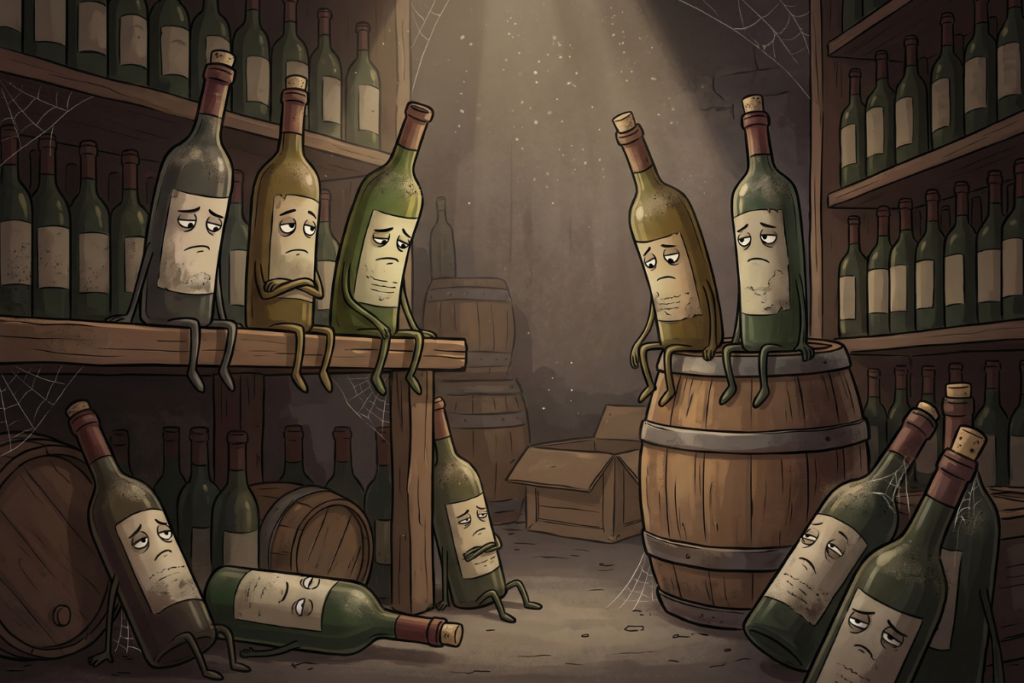
Italian wine in its Swot analyses almost always gives the impression of giving importance to weaknesses and critical issues instead of making better use of strengths and opportunities. And this is even more serious in such a complex market phase during which those who do not have strong convictions and a healthy pride of belonging truly risk disappearing from the scene or remaining on the margins. Finally, Teresa’s objections made me better understand another important factor.
Her objections were in fact shared by the majority of her fellow producers present in that room. The success of a denomination is also strongly linked to the community, an element too often overlooked among the factors of terroir. Instead, the community and the ability to create a strong and shared awareness around a denomination is a determining strategic factor for the success of that territory and that type of wine.
But how many strong and aware wine communities do we have today in our wine sector? I cannot give a precise number, but I am absolutely convinced that there are far fewer than there could be, and this worries me more than the current market situation.
Key Points
- Lack of self-esteem prevents Italian wine denominations from achieving their deserved global market success and recognition.
- Constructive international comparisons are essential to build awareness and avoid dangerous self-referentiality in the wine sector.
- Focusing on strengths rather than weaknesses is crucial for survival in today’s highly competitive wine market.
- Building a strong community creates shared awareness and acts as a determining strategic factor for terroir success.