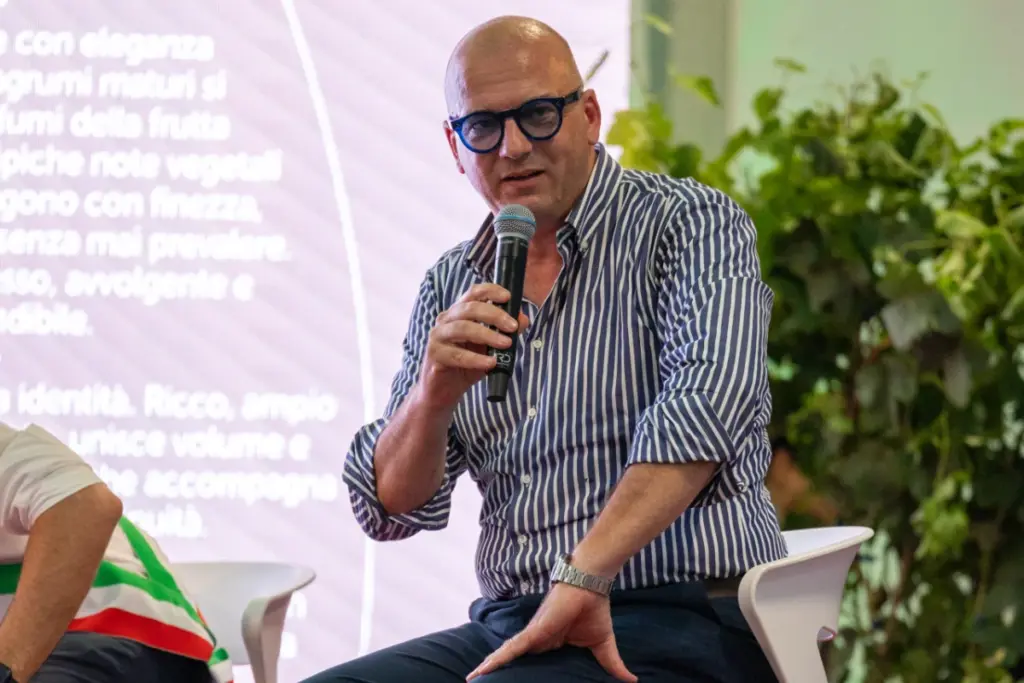
Chartered accountant Luca Castagnetti presented his annual analysis of Italian wine companies at Envisioning 2035 in Milan. Drawing on data from roughly a thousand firms, he showed declining revenues and profitability, warned that cash generation determines survival, and outlined how business networks, banking relationships, and public funding could support real recovery.
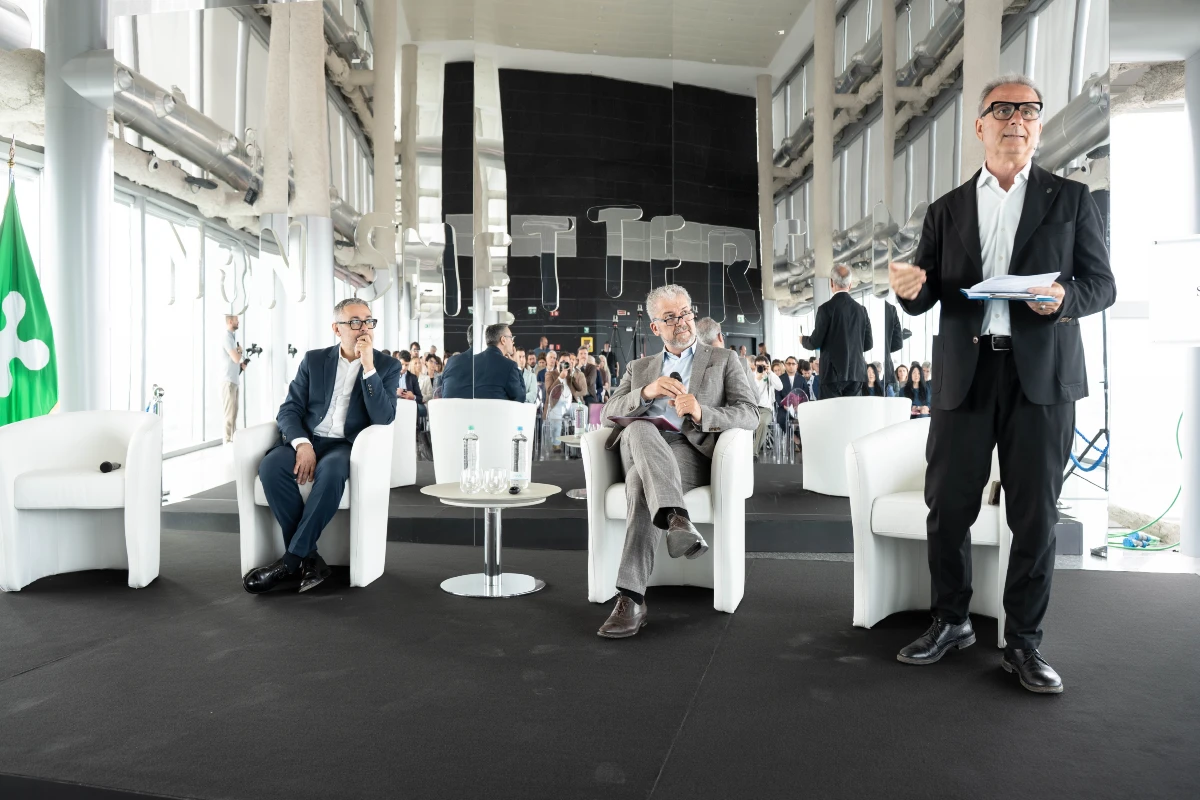
On Thursday, June 4, 2026, on the Belvedere Terrace of the Lombardy Regional Government Palace in Milan, the second edition of Envisioning 2035, Wine [R]evolution was held, the event organized by Wine Meridian with the support of FreedL Group. It brings together entrepreneurs, managers and analysts of Italian wine to build a shared understanding of the challenges and possible strategies looking ahead to 2035.
The real figures of the companies were brought to the stage by Luca Castagnetti, a chartered accountant and founder of the Centro Studi Management DiVino at Studio Impresa, a profile described by Wine Meridian director Fabio Piccoli, who moderated the meeting, as “a sort of general practitioner for wine companies.” Since 2019, Castagnetti has systematically monitored a sample of about a thousand companies in the sector with revenues of over one million euros.
His is a rare perspective in the Italian landscape: he sees every year who is truly growing, who stays afloat thanks to rural development subsidies or the value of their land, and who instead hides real marginality behind accounting that does not tell the whole story.
More than half of companies in decline
The analysis presented by Castagnetti starts from the 2024 data in his observatory: “Already in 2024, roughly 50% of companies showed declining revenues and profitability.” This figure, however, tells only part of the picture. Even where nominal revenues had grown, adjusting for inflation changes the perspective: “If we deflate it, there was no growth at all, not even in 2024.”
The most recent estimates from Mediobanca on companies with revenues over 20 million euros confirm the trend for 2025: revenues down 2.8%, profitability down 4.2% at the Ebitda level and 9.5% at the Ebit level. In 2024, the Ebitda of the same sample had improved by 15%: the contrast is stark.
The new development, strongly emphasized by Castagnetti, is that “today more than 52% of medium to large companies are in decline, whereas in 2024 companies in decline were fewer than 30%.” One cannot help but wonder what is happening to smaller companies, those that were already seeing their margins shrink in 2024.
The value of vineyards remains a powerful asset anchor for many businesses, but Castagnetti warns that it risks obscuring the fundamental variables that need to be monitored during difficult periods.
The variable that decides everything: cash flow
In a sector where the value of land often guarantees apparent solidity, the harshest variable for measuring a company’s real health remains only one: “If you generate cash you live, if you don’t generate cash you die. This is the harshest reality.” This is not a metaphor. In the weeks preceding the event, major Italian wineries had entered crisis proceedings: the Zonin case loomed in the background for the Envisioning 2035 audience.
Generating liquidity in the wine business, however, means dealing with a structurally long supply chain: “We are talking about a minimum period of 10 years,” explained Castagnetti, referring to the time that passes between planting a vineyard and positioning the product on the market. “The long term is something we need to reclaim. Wine is a long term business, and as such strategic choices must be made on at least a decade long horizon.”
Among the most immediate risks, Castagnetti cited the excess stock in the warehouses of wineries and importers, a consequence of the ongoing destocking: “If you need to generate cash you have to sell your inventory, and to sell your inventory you probably have to run commercial promotions tied to discounting. Promotions in a sluggish market do not deliver the expected results and, above all, penalize the company in the long run.”
According to Castagnetti, those who succeed will be the ones able to use their financial resources to improve their offering, particularly through brand acquisitions. When the market is weak, promotions are ineffective and counterproductive in the medium to long term. “Revenue cannot be won customer by customer, but extraordinary operations can make you faster. Unfortunately these are very difficult to carry out and require considerable managerial solidity on the part of the buyer. Otherwise you end up hurting yourself.”
Business networks: three models, one real obstacle
As one of the leading promoters of business networks in the Italian wine sector, Castagnetti has contributed to more than 130 aggregation projects, more than 25 of them in the wine world. On the Envisioning 2035 stage he precisely distinguished three types, with very different characteristics and critical issues.
Networks among companies belonging to the same group, linked by common ownership, “work well, and too few of them are created”: they are effective in solving organizational issues and improving work processes. Networks between wineries and grape suppliers give stability to the supply chain and improve product quality, even though several producers are dismantling them because they prefer to reduce grape purchases from third parties and invest instead in directly managed vineyards. The most complex networks remain those between different brands aiming to control markets: harmonizing commercial policies means harmonizing people, with everything that this entails.
According to Castagnetti, the key to success lies in five precise ingredients: “A very clear and explicit shared purpose, a division of responsibilities, recognized leadership, systematic monitoring of results and, finally, reasonable trust.” On this last point he chose an image that left a mark on the audience: “Trust is a product that is refined over time, while it is destroyed by a single hailstorm.”
To those who consider the business network model a failure, Castagnetti responded by pointing to a cultural cause rather than a structural one: “There is too much haste in judging results. When the strategic relationship is light, as an aggregation can be, an immediate result is expected, and if it does not come people give up too soon.”
A network, in the end, is like an aging wine: at first it does not work, and it often creates confusion and higher costs. Then things change, and it recovers in speed and effectiveness.
Banks, consortia and public funding: no conspiracy, but a lot of unpreparedness
One of the most direct questions of the day concerned the role of banks, consortia and regional funds in managing the crisis. Castagnetti answered candidly, without giving in to the temptation of oversimplification: “There is no conspiracy of silence, but an unpreparedness to face a period of crisis after years of growth. Which is perhaps worse.”
Banks know the accounts of wineries and are concerned about their own exposure, even though the percentage of non performing loans in the sector is lower than the national average. Cash generation is the first KPI to consider when markets are weak, and banks understand this better than the companies themselves. The guarantees offered by land, Castagnetti recalled, are a last resort: not a strength, but a parachute nobody wants to open.
Consortia have powerful tools, they can open or close the taps on vineyard yields and redesign the production regulations, but the current representation system makes these decisions politically very difficult. “The consortia most affected by today’s crisis should have the courage to ask themselves what is truly beneficial for the appellation as a whole, rather than what benefits one member or another.” A call that sounds familiar even outside the wine world.
On the subject of public funding, Castagnetti’s reasoning is clear cut: agriculture is an excessively subsidized sector, and when subsidies and tax credits together reduce the weight of an investment to a minimum, companies stop asking themselves who they will actually sell the wine to. “The supply side is being propped up artificially.” His proposal is equally clear: every public resource should, today and in the coming years, be devoted exclusively to supporting demand, meaning commercial processes, export, and communication, in order to secure new markets and change how young people perceive wine.
The structural intervention nobody wants to address
On the sector’s major crises, overproduction, falling consumption, tariffs, system level interventions have almost always responded downstream, addressing symptoms: crisis distillation, incentivized uprooting, subsidies. Castagnetti, who knows balance sheets from the inside, shifted the perspective upstream.
“A winery is a business. It seems like an obvious statement. Yet it is not.” In recent years, the wine product has captured all the attention, inside and outside wineries, leaving in the background the most urgent question: what characteristics must a winery business have to be competitive and create value in a difficult market? There is no structural measure that can uniformly change the fate of Italian wine SMEs, he explained, “but only greater awareness among operators of how a business should act: targeted investments, competent people, corporate culture, processes monitored and improved over time, adequate communication.”
In short: truly being a business. And on this point, Castagnetti chose to close with a note of lucid optimism: “I am optimistic about the future of the sector, because there are still many open and available working hypotheses, and plenty of wineries that can undertake a virtuous path of business improvement.”
Key points
- Profitability among medium to large wine companies has worsened sharply, affecting over 52% in 2025.
- Cash generation, not land value, determines whether a wine business survives or fails.
- Business networks succeed through clear purpose, leadership, accountability, and patient trust building.
- Public funding should shift from supporting supply to strengthening demand and export.
- Long term thinking, spanning at least a decade, is essential for wine sector strategy.