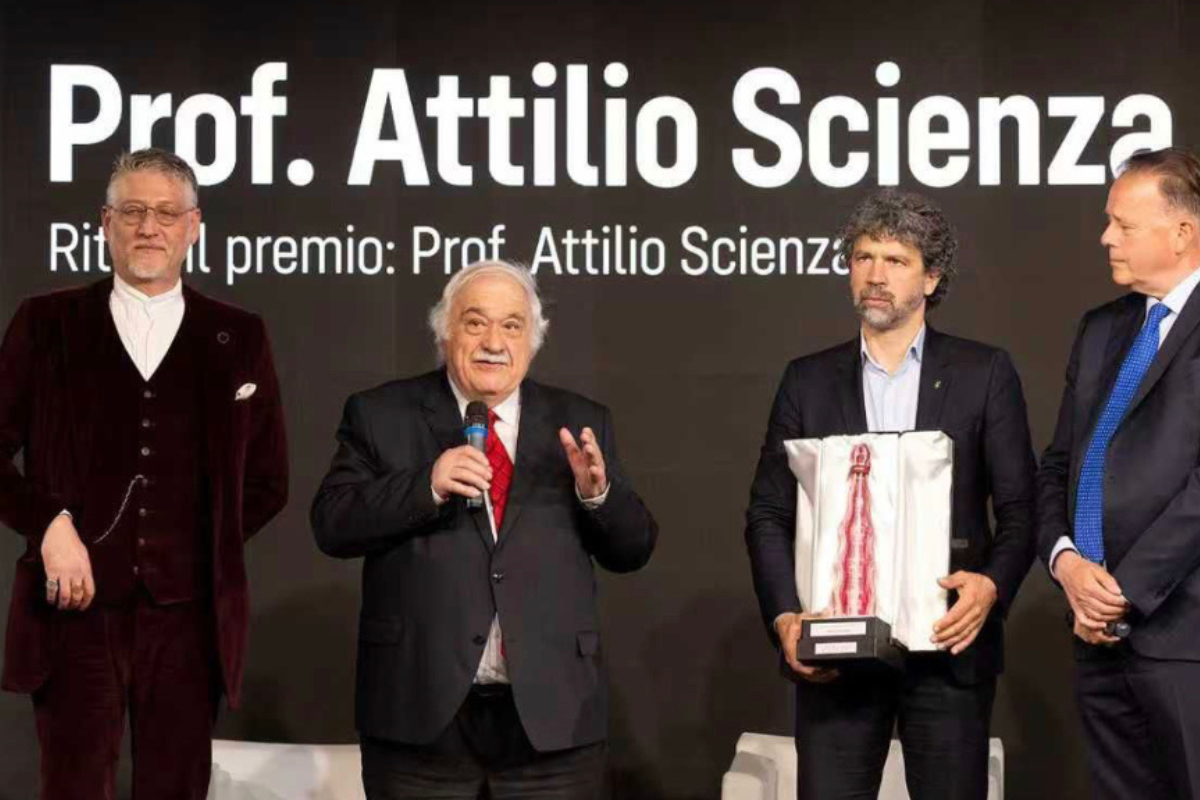
At Vinitaly 2025, professor Attilio Scienza, awarded for his career, offered the most compelling intervention of the fair. Beyond market figures and trade rhetoric, he called for a genuine cultural manifesto for Italian wine: a shared vision capable of repositioning it as a founding element of European civilisation and Mediterranean identity, particularly relevant for younger generations.
For me, among the many encounters of this latest edition of Vinitaly, the one with Attilio Scienza was the most important. It was so not only because of the stature of the man, whom I have known and admired for many years, but because amid days dense with words often already heard, repeated formulas, and truths sometimes partial or prudently concealed, the dialogue with him carried a different weight, a different temperature.
It was one of those moments in which wine ceases to be merely a market, a representation, a sectorial rhetoric, and returns to being thought, responsibility, vision. With Attilio Scienza, one always has the sense that the conversation never stops at the surface. His words are full of awareness, courage, and cultural depth. Above all, they contain something extremely rare today: a genuine exhortation. A call to action, rather than a simple commentary on the present.
I do not think I am exaggerating when I say that today Scienza, rightly awarded at Vinitaly with a career recognition, represents the most authoritative voice of Italian wine, and also its most visionary, open, and courageous one. A prize that was, in a way, almost inevitable, and yet insufficient in relation to the value of a man who has left a structural mark on Italian oenological thought.
The motivation of the award describes him as “a central figure in the history of Italian wine, an internationally renowned academic, vine geneticist, agronomist and narrator of wine anthropology,” underlining his decisive contribution to the study of wine as a cultural expression, to education, and to the definition of key concepts such as terroir, identity, and tradition. It is an accurate portrait, even an elegant one. But those who know his work understand there is more: Scienza did not simply explain Italian wine, he helped it develop a consciousness of itself.
And it is perhaps this consciousness that emerged as the most urgent point from our conversation. Scienza begins with a sharp, even severe, but necessary critique: Italian wine continues too often to miss decisive opportunities to organise itself culturally, before doing so economically or politically. The sector, he says in substance, remains fragmented, prisoner of a false independence that, rather than generating shared strength, produces division, sterile competition, and individualism.
And so even the great events – even those that could become places of synthesis and direction – risk stopping at the aesthetic, representative, self-celebratory dimension. This is where one of the strongest insights of his reasoning emerges: Vinitaly should have the courage to become, each year, a laboratory of thought, rather than merely a showcase. It should produce a manifesto, one capable of stating clearly what has happened, what the current critical issues are, what priorities the sector intends to set, and what proposals it wishes to put forward.
The problem with Italian wine is the absence of a shared vision, and without vision, even the responses risk being weak.
A manifesto that is a cultural and political platform, a real point of aggregation among productive categories, consumers, institutions, research, and territories. Not a sum of declarations. This is a crucial shift, because it moves the centre of gravity of the debate: the challenge for Italian wine is a structural one, extending well beyond the current economic climate, market fluctuations, falling consumption, or regulatory pressure.
Scienza says this with disarming clarity: it is insufficient for politics to distribute resources or try to patch up emergencies. Putting a few million here and there, hoping the problem resolves itself, can even worsen things if not accompanied by strong thinking and a redefinition of the role of wine in contemporary society. He also rightly points out that the feeling of fear, which runs through many wine entrepreneurs and managers, leads to contingent decisions, such as seeking a single grant, while preventing any organic planning of an effective response, both for individual companies and for the sector as a whole.
His most important statement, in my view, is also the simplest and most powerful: today we must defend, not the interest of a region, a denomination, or a category. We must defend wine. Defending wine at a moment when it is under attack from multiple fronts: health-related oversimplifications, increasingly aggressive ideological narratives, competition from other consumption models, a segment of younger generations that seems to seek its identity symbols elsewhere, and also the sector’s own inability to convincingly reformulate its meaning in the present.
The true strength of Scienza’s reasoning lies in the fact that this defence is never conceived in closed, corporate, or chauvinist terms. On the contrary. One of the most illuminating passages of our conversation concerns precisely the historical paradox we are living through: even Trump’s anti-Europeanism can, indirectly, represent an opportunity. Not because there is anything to welcome in that political posture, but because a Europe placed under pressure, contested or challenged from outside, is finally compelled to recognise itself, to feel itself, to define itself with greater force.
This is where wine returns to a central position in a new and deeper way, not as a partisan banner, not as an identity weapon wielded aggressively, but as a founding element of a European civilisation. A civilisation of living, of measure, of the relationship between food, landscape, agriculture, time, conviviality, and knowledge. In this sense, the defence of wine becomes credible and authoritative precisely when it ceases to be a sectoral defence and transforms into a cultural awakening: recognising oneself as European, not through exclusion or superiority, but through belonging to a history, a sensibility, a way of life in which wine has held an essential place for centuries.
This shift is decisive. It moves the question from the economic plane to the civic one. It also points to a possible response to the present: Italian wine, and with it European wine, can truly defend itself only by repositioning itself within a broader narrative, one capable of speaking to society as a whole, beyond producers alone. A narrative that does not oppose wine to the contemporary world, but rethinks it as one of the most mature and historically rich expressions of Mediterranean and European civilisation, one that has allowed it to become an extraordinary instrument of socialisation. And never as today, particularly for younger generations, the theme of socialisation, of being together, is fundamental and decisive for the wellbeing of our societies.
It is in this perspective that the title of the conference Scienza mentioned takes on decisive significance: “In Praise of Measure. Scientific Truths to Defend the Mediterranean Model”, organised by Prof. Fulvio Mattivi at the Fondazione Olmo, scheduled for 8 May at the Artimino estate in Carmignano (Prato). A beautiful title, because it immediately returns us to the heart of the matter. The key word is measure. Not excess, not denial, not propaganda, but measure. And alongside it, the need to bring scientific truths back to the centre, rescuing the debate on wine from both the banalisations of marketing and ideological demonisation.
The defence of wine, in other words, can no longer take place on the narrow ground of sectoral self-defence. It must become part of a broader defence: that of a civilisation of living, a Mediterranean model grounded in the relationship between food, territory, time, conviviality, knowledge, landscape, agriculture, and memory. Wine, in this design, is central. Yet it must be told in a way that is far from self-referential: it must be embedded in a vision of society. And, as Scienza suggests, in a fuller and more deeply felt European consciousness.
The conversation with Scienza thus proved, for me, far more than an interview. It was an encounter with an idea of contemporary wine still entirely to be defined, yet already clear in its essential contours. A wine that cannot keep taking refuge either in the nostalgic cult of the past or in the identity shortcuts of the present; a wine that does not save itself by chasing generic labels or lexical fashions, but by reclaiming its place within a living culture.
From here arise the most uncomfortable and most fertile questions: what does “contemporary wine” truly mean today? How can it speak to new generations without losing its essence? How can it emancipate itself from its own oversimplifications, from the sterile oppositions between natural and conventional, tradition and innovation, authenticity and positioning? These are open questions, but finally honest ones. And the merit of Attilio Scienza lies precisely in this: offering no easy formulas, but compelling the sector to look inward, to define its boundaries, to rediscover a more honest and more profound language.
Perhaps this is why, after so many words heard during the days of the fair, those of Scienza carried a different resonance. Because they were seeking truth, not immediate consensus. And truth, when it arrives, creates crisis. But it also liberates. It opens. It compels us to choose. Italian wine today needs precisely this: not a narrative makeover, not another season of slogans, but a new Renaissance, a time to think of itself once again as a cultural system, before it is a production chain. A time to recompose scattered energies under a shared idea, capable of uniting science, territory, enterprise, education, and civic vision.
Attilio Scienza, with the force of his words and the authority of his history, points to this path. It would be desirable for the sector to finally have the courage to follow it. Because today, more than ever, this is not merely about promoting Italian wine. It is about understanding its deeper meaning, defending its cultural dignity, and restoring the place it deserves in the narrative of our time. And perhaps also about rediscovering, in the tensions of the present, a forgotten truth: that wine belongs not only to a market, but to a civilisation, and that defending it well means, above all, fully recognising oneself in that European civilisation of which it is one of the deepest and most vital symbols.
Key points
- Italian wine suffers from a lack of shared cultural vision, beyond fragmentation and sterile competition between categories.
- Vinitaly should become an annual laboratory of ideas, producing a cultural and political manifesto for the sector.
- Wine must be defended as an expression of European civilisation and the Mediterranean model, not as a corporate interest.
- Fear-driven decisions among wine entrepreneurs block long-term strategic planning and systemic sector response.
- The conference “In Praise of Measure” (8 May, Artimino) places scientific truth at the centre of wine’s cultural defence.